
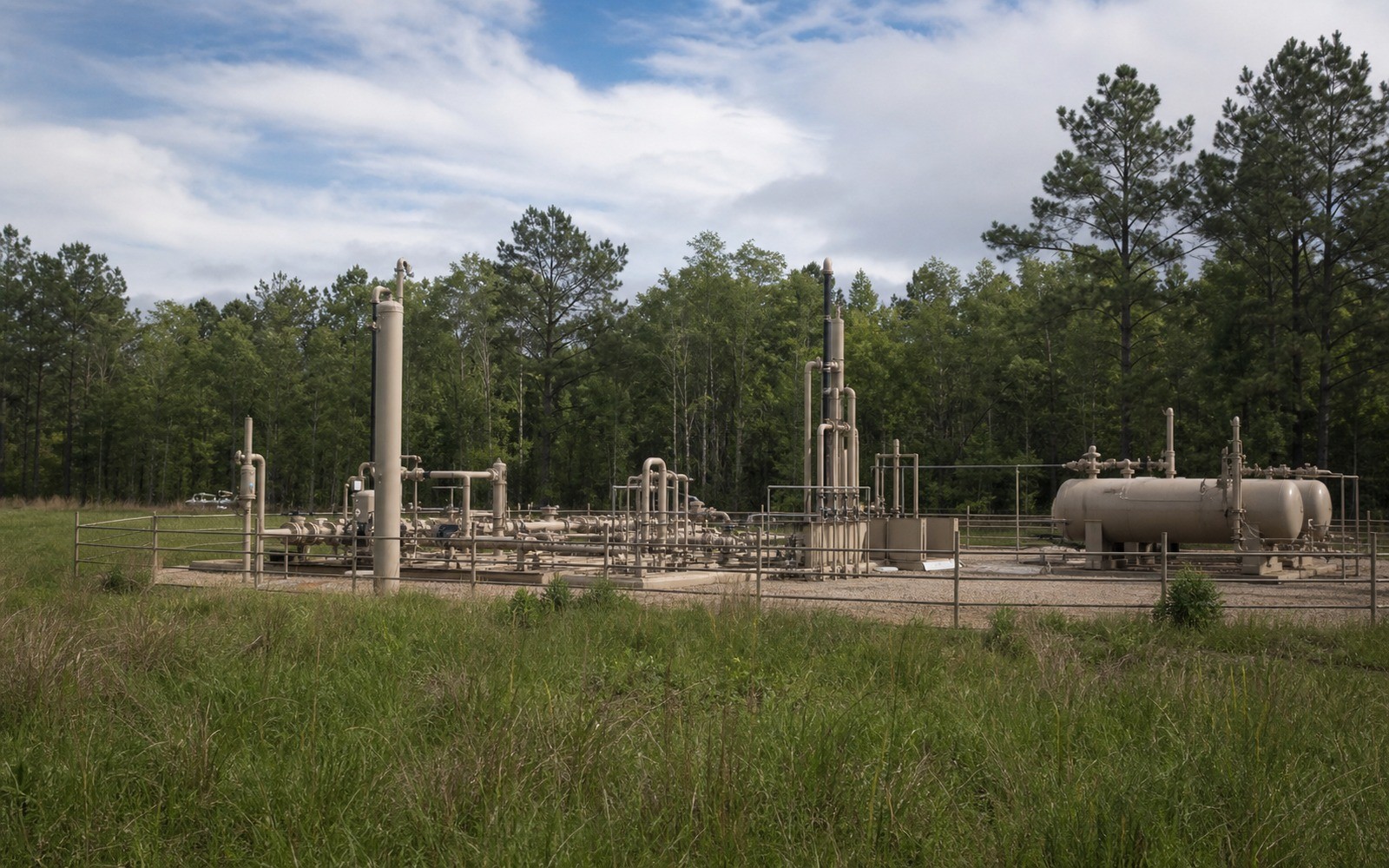
Haynesville Shale Mineral Rights
A Haynesville check moves with the natural gas strip in a way an oil interest never does, so our review starts with where Henry Hub is trading and where the futures curve points before we look at anything else.
The Haynesville runs through northwest Louisiana and East Texas, spanning Caddo, DeSoto, and Red River Parish on the Louisiana side and Panola and Harrison counties on the Texas side, and it is one of the most prolific dry gas plays in the country because of the formation's high pressure and thickness. Wells here can post very high initial production rates, but they also decline steeply in the first year or two before settling into a longer tail.
Demand from Gulf Coast LNG export facilities, including projects like Golden Pass and the broader buildout along the Louisiana and Texas coast, has been a real driver of continued Haynesville development in a way that sets it apart from some other mature gas basins. Our underwriting reflects that connection between the play and export demand directly.
Why strip price sensitivity dominates the model here
Because Haynesville wells are dry gas with high initial rates, revenue swings with the gas strip more directly and more immediately than in an oil-weighted play, where a broader mix of products can smooth out some volatility. We look at where the current Henry Hub strip sits and how the forward curve is shaped, since a tract's near-term cash flow is more exposed to that price path than an equivalent oil interest would be.
This means our valuation range for a Haynesville tract can move more with broader gas market conditions than a comparable Permian or Bakken tract would, and we explain that directly to owners rather than quoting a single number as if gas prices were static.
How LNG export demand changes the operator picture
Operators active in the Haynesville have generally kept drilling programs tied more closely to Gulf Coast export demand than to domestic gas prices alone, since a meaningful share of the gas produced here is ultimately headed toward liquefaction facilities. We check whether a tract sits near an operator with continued permitting activity tied to that export-linked demand, since that tends to be a better signal of near-term development than domestic gas pricing by itself.
Where an operator has pulled back rigs during a period of weaker domestic pricing, we look at whether that pullback appears temporary and pricing-driven or reflects a broader shift away from the specific spacing unit, since those two situations lead to different underwriting conclusions.
Deduction review on high-pressure wells
Haynesville wells often require more intensive gathering, compression, and processing infrastructure than shallower gas plays because of the depth and pressure involved, and that infrastructure cost frequently shows up as deductions on the royalty statement. We ask for the current operator statement to see exactly how those deductions are structured before finalizing any review, since they can meaningfully affect the net number an owner is actually receiving relative to the gross wellhead value.
This is one of the more important documents we request in this basin specifically, more so than in a shallower, lower-pressure gas play, because the deduction structure here tends to be more material to the final number.
Bossier bench upside layered under the Haynesville
In parts of the play, particularly across DeSoto and Red River Parish, operators have begun co-developing the deeper Bossier Shale underneath the primary Haynesville bench, which adds a second landing zone to sections that would otherwise be considered fully drilled. We check permit and completion records specifically for Bossier activity before assuming a tract's inventory is limited to whatever Haynesville wells are already producing.
A tract with both benches confirmed productive, or with permits filed for a Bossier test near an established Haynesville unit, generally reads as carrying more remaining inventory than one where only the shallower zone has ever been touched, and we weight that difference directly in how we underwrite a package.
Questions Owners Ask the Acquisition Desk
Why does my Haynesville royalty check swing around so much month to month?
Haynesville wells are dry gas with high initial rates, so the check is more directly exposed to natural gas strip pricing than an oil interest, and that pricing can move meaningfully month to month depending on broader market conditions.
Does LNG export demand actually affect my specific well?
It can, since a meaningful share of Haynesville gas is ultimately linked to Gulf Coast export demand, and we check whether the operator active in your unit has continued permitting tied to that demand when we review a tract.
What deductions should I expect to see on a Haynesville statement?
Gathering, compression, and processing charges tend to be more significant here than in shallower gas plays because of the depth and pressure involved, so we review the operator's statement closely to understand the net-to-gross relationship.
Is now a good time to sell given how gas prices move around?
We do not give timing advice on when to sell, since that depends on your own financial situation and how much price exposure you want to carry, but we do explain how current strip pricing factors into how we underwrite a tract.
Want a range built from your statements, acreage, lease, activity, and ownership records?
Send the county and state, owner name, operator or payor, recent statement, deed reference, lease, division order, probate record, or written offer you have.